Major and trace element data, obtained by electron microprobe and laser
ablation microprobe (LAM) ICPMS on individual sulfide grains enclosed
in xenocrystic olivine and pyroxenes from kimberlites in the Lac de
Gras area, Slave Craton, provide new information on the age and origin
of the lithospheric mantle. Ca-in-olivine temperatures
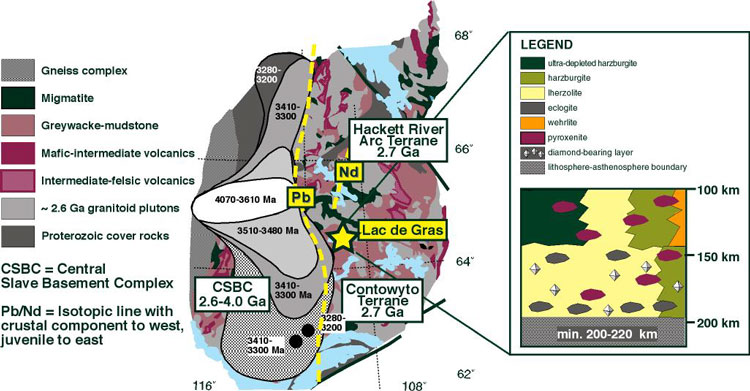
(Köhler and Brey 1990) from ~1100 - 1300°C indicate that the
host olivine grains are derived from the deeper, less depleted layer of
the stratified lithospheric mantle beneath Lac de Gras (Griffin et al.
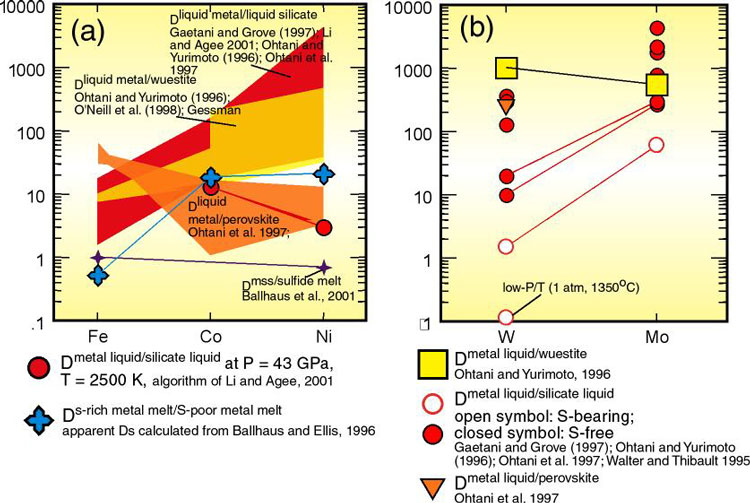
1999) (Image 1). There are two major sulfide populations: nickeliferous
monosulfide solid solution (mss), and a distinct group of S-deficient
Ni- and Co-rich sulfides, many of which have high W contents (Image 2).
An Fe metal grain is also found in the inclusion suite. Platinum-group
element contents of many mss suggest an origin by igneous fractionation
of primitive sulfide melts. Weak negative co-variations of sulfide Os
contents, Pd/Os and Re/Os with host olivine Mg/(Mg+Fe) are broadly
consistent with an igneous origin and variable degrees of partial
melting, suggesting polybaric melting in an upwelling mantle volume
that was subcreted to the pre-existing shallow lithosphere.
Based on published partition coefficients (Image 3), the W-enrichment
and high W/Mo, high Ni/Fe and low Ni/Co observed in a subset of samples
are interpreted as a memory of formation at sublithospheric, possibly
lower mantle conditions. The mss, Ni-Co-rich sulfides and the Fe metal
grain, which has strong Ni and Co depletions, may have formed in three
steps: (1) The low Ni/Co was acquired by equilibration of the
metal-rich sulfide melt with silicic liquid at mid-mantle pressure
where DCometal melt/silicate melt becomes equal to DNimetal melt/silicate melt (Li and Agee 2001) (2) The high DWmetal melt/Mg-wüstite relative to DMometal melt/Mg-wüstite and DWmetal melt/silicate melt
(Ohtani and Yurimoto 1996) suggests that high W contents and W/Mo were
acquired by subsequent percolation of the metal-rich sulfide melt
through the lower mantle. (3) Cooling led to exsolution of this melt
into S-rich and S-poor immiscible melts (Ballhaus and Ellis 1996), with
concomitant partitioning of Ni and Co into the S-rich melt, and
depletion of these elements in the S-poor melt, consistent with the
negative anomalies observed in the Fe metal.
Re-Os isotope data were collected in situ for
23 Fe-rich mss inclusions by LAM multi-collector (MC) ICPMS. Eleven
monosulfide solid solution samples form an isochron at t = 3.27
± 0.24 Ga, with a precise enriched initial 187Os/188Os at t of 0.10725 ± 0.00014 ( Os
= 5.67 ± 0.14; MSWD = 0.75). Regression of this population plus
6 samples that may have underestimated Re due to non-modal sampling of
low-temperature assemblages during laser ablation, yields an
“errorchron” of 3.13 ± 0.97 Ga, with initial 187Os/188Os of 0.1095 ± 0.0025 (Os = 7.89 ± 2.46; MSWD = 111) (Image 4). The radiogenic initial 187Os/188Os
points to a source with long-term suprachondritic Re/Os. This source
may reside in the sublithospheric mantle, consistent with the presence
of ultra-high pressure sulfides (this study) and lower mantle
inclusions in diamond (Davies et al., 1999). It was sampled by
upwelling peridotite that lost variable amounts of partial melts, in
accord with co-variations between sulfide isotopic and trace element
compositions and between sulfide isotopic and host olivine composition.
Os
= 5.67 ± 0.14; MSWD = 0.75). Regression of this population plus
6 samples that may have underestimated Re due to non-modal sampling of
low-temperature assemblages during laser ablation, yields an
“errorchron” of 3.13 ± 0.97 Ga, with initial 187Os/188Os of 0.1095 ± 0.0025 (Os = 7.89 ± 2.46; MSWD = 111) (Image 4). The radiogenic initial 187Os/188Os
points to a source with long-term suprachondritic Re/Os. This source
may reside in the sublithospheric mantle, consistent with the presence
of ultra-high pressure sulfides (this study) and lower mantle
inclusions in diamond (Davies et al., 1999). It was sampled by
upwelling peridotite that lost variable amounts of partial melts, in
accord with co-variations between sulfide isotopic and trace element
compositions and between sulfide isotopic and host olivine composition.
The isochron age is significantly older than the overlying crust, which
forms part of the arc-related 2.7 Ga Contwoyto terrane, but corresponds
to a period of extensive crust formation in the adjacent Central Slave
Basement Complex (CSBC; Bleeker et al. 1999) (Image 5). This “age
paradox” may be reconciled if ~3.27 Ga lithospheric mantle beneath the
CSBC, which was subcreted during mantle upwelling, was thrust beneath
the younger Contwoyto terrane, east of the CSBC during collision of
these terranes at ~2.7 Ga, resulting in a translithospheric
east-dipping suture that coincides with the observed mantle
stratification (Image 6). If subcretion of 187Os-enriched
or isotopically heterogeneous upwelling peridotite was a major mode of
lithosphere formation in the Archaean, the assumption of a uniform
reservoir with broadly chondritic isotopic composition for the
calculation of Re-Os model ages may need to be reassessed.
References
Ballhaus, C., Ellis, D.J., 1996. Mobility of core melts during Earth's accretion. Earth Planet. Sci. Lett. 143, 137-145
Bleeker, W., Ketchum, J., Jackson, W., Villeneuve, M. (1999) The
Central Slave Basement Complex, Part I: its structural topology and
autochthonous core. Can. J. Earth Sci., 36:1111-1130
Davies, R.M., Griffin, W.L., Pearson, N.J., Andrew, A.S., Doyle, B.J.,
O'Reilly, S.Y., 1999. Diamonds from the deep: Pipe DO-27, Slave Craton,
Canada. Proc. 7th Int. Kimb. Conf. Red Roof Design cc, Cape Town, pp.
148-155
Griffin, W.L., Doyle, B., Ryan, C., Pearson, N., O’Reilly, S., Davies,
R., Kivi, K., Achterbergh, E.V., Natapov, L. (1999) Layered Mantle
Lithosphere in the Lac de Gras Area, Slave Craton: Composition,
Structure and Origin. J. Petrol., 40:705-727
Köhler Köhler, T.P., Brey, G.P., 1990. Calcium exchange
between olivine and clinopyroxene calibrated as a geothermometer for
natural peridotites from 2 to 60 kb with applications. Geochim.
Cosmochim. Acta 54, 2375-2388
Li, J., Agee, C.B., 2001. The effect of pressure, temperature, oxygen
fugacity and composition on partioning of nickel and cobalt between
liquid Fe-Ni-S alloy and liquid silicate: Implications for the Earth's
core formation. Geochim. Cosmochim. Acta 65, 1821-1832
Ohtani, E., Yurimoto, H., 1996. Element partitioning between metallic
liquid, magnesiowuestite, and silicate liquid at 20 GPa and 2500°
C: a secondary ion mass spectrometric study. Geophys. Res. Lett. 23,
1993-1996
Image 1: Map of the Slave Craton after
Padgham and Fyson (1992), showing the units defined by Bleeker et al
(1999) in the west and the domains defined by Kusky (1989) in the east.
Also shown are the Pb isotopic line of Thorpe et al (1992, as quoted
in: Pell, 1997) and the Nd isotopic line of Davis and Hegner (1992).
The latter is interpreted by Bleeker et al (1999) as the leading edge
of the suture between the CSBC and the eastern part of the craton.
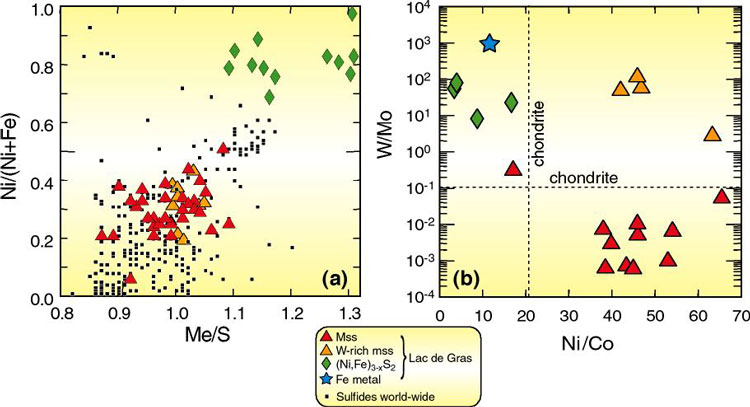
Image 2: (a) Metal/sulfur (Me/S) versus Ni/(Ni+Fe) for mss and
Ni-Co-rich sulfides from Lac de Gras, and occurring in basalts,
pyroxenites, peridotites, olivine megacrysts and diamonds world-wide
(compiled from the literature).(b) Ni/Co versus W/Mo for sulfides and
Fe metal from Lac de Gras. Chondritic ratios from McDonough and Sun
(1995).
Image 3: Partition coefficients
for the distribution of (a) Fe, Co, Ni, (b) W and Mo between liquid
metal or sulfide. and silicate liquid, perovskite or Mg-wüstite.
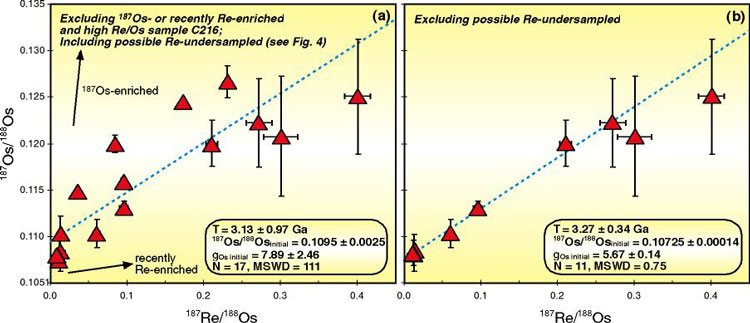
Image 4: Isochron (model 1 solution;
using ‘isoplot’ of Ludwig, 1999) with (a) 17 samples after exclusion of
samples with disturbed 187Os/188Os and 187Re/188Os and (b) 11 samples,
after additional exclusion of possibly Re-undersampled sulfides, due to
non-modal sampling of low-temperature assemblages during laser
ablation. Error bars are 2se.

Image5: Possible reconstructions of the
tectonic history of the Slave craton incorporating elements of Kusky
(1989) and Bleeker et al., (1999), and references therein, and
satisfying the ~3.3 Ga age of the deep lithospheric mantle stratum
constrained by sulfide Re-Os ages and the 2.7 Ga age of the overlying
crust

Back
© Copyright Macquarie University | Privacy Statement | Accessibility Information
Site Publisher: DVC Development and External Relations | Last Updated: 18 August 2008
ABN 90 952 801 237 | CRICOS Provider No 00002J